If you own a business in Centennial, the right industrial or flex space can do more than house your operations. It can improve workflow, support growth, and give you more control over costs and decision-making over time. This guide will help you understand how Centennial industrial and flex properties work, what local subareas matter most, and what to verify before you buy. Let’s dive in.
Why Centennial Matters for Owners
Centennial is a large south Denver market with about 108,000 residents and more than 5,000 businesses. Its industry base includes construction, manufacturing, wholesale trade, transportation, warehousing, utilities, professional services, finance, education, healthcare, and retail. That mix matters because industrial and flex demand here is often tied to local operating businesses, not just big-box logistics users.
For owners, that creates a practical market with a range of use cases. You may be looking for contractor space, light manufacturing, warehouse capacity, showroom functionality, or a hybrid office and operations setup. Centennial supports all of those needs, but the fit depends heavily on zoning, corridor, and building design.
What Industrial and Flex Space Means
Industrial space generally covers buildings used for manufacturing, research and development, production, maintenance, and storage or distribution of goods. NAIOP groups it into three broad categories: manufacturing, warehouse and distribution, and flex. That gives you a useful starting point when comparing properties.
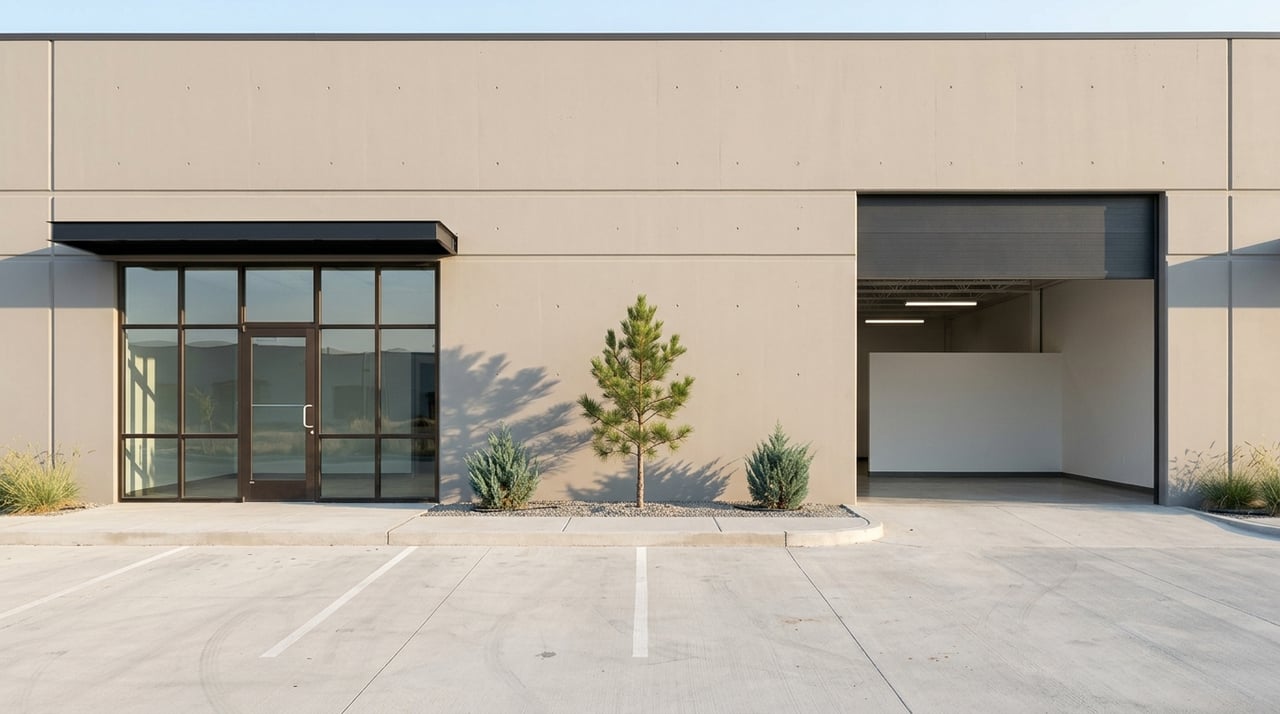
Flex space is especially relevant in Centennial. It is designed for multiple uses and can shift between office and warehouse functions, with at least 20% of the floor area typically devoted to office use. In practice, that makes flex attractive for service businesses, showrooms, contractors, and companies that need both customer-facing and operational space in one location.
Key Building Features to Compare
When you tour industrial or flex space in Centennial, square footage alone will not tell you enough. Operational fit often comes down to a handful of physical details that affect day-to-day use and future flexibility.
Focus on these features when comparing options:
- Clear height, or the usable vertical distance inside the building
- Loading configuration, including dock-high and drive-in doors
- Truck-court depth, which affects maneuvering and loading efficiency
- Office ratio, especially if you need showroom or admin space
- Parking, for staff, customers, or fleet vehicles
- Yard or outside storage area, if your business needs it
A building with the wrong loading setup or too much office buildout can create expensive inefficiencies. A building with the right fundamentals may support your business for years with fewer changes.
Centennial Zoning Can Change the Deal
One of the biggest mistakes owners make is assuming all industrial-like properties allow the same uses. In Centennial, the Business Park districts and the Industrial district are not interchangeable. That distinction can affect what you can do now and what you may be able to do later.
The city says Business Park districts allow offices and enclosed light industrial uses in a campus-like setting. The Industrial district allows a broader range of industrial uses, subject to performance standards. Height limits also vary by district, with current summary caps shown at 35 feet in BP35, 50 feet in BP50, 75 feet in BP75, 100 feet in BP100, and 50 feet in the Industrial district.
That said, Centennial also notes its zoning summary page may not reflect the most accurate information after 2024 updates. Before you move forward on any acquisition, the final check should be the Land Development Code and the parcel-specific zoning map. For an owner-user, that step is critical if your plan includes future expansion, outdoor storage, operational changes, or redevelopment.
Corridors to Watch in Centennial
Centennial industrial and flex real estate is not just a building story. It is also a corridor story. Some areas are evolving toward mixed-use environments, while others remain more stable for working-space uses.
Midtown Centennial
Midtown Centennial is one of the most important areas to understand. It runs from South Yosemite to South Havana and from East Arapahoe to East County Line, centered around the Dry Creek Light Rail Station, I-25, Centennial Airport, and a growing mixed-use district.
This matters because location strategy in Midtown is changing. If you own or plan to buy here, you should think beyond the building itself and consider how future land use, traffic patterns, and surrounding redevelopment could affect operations and long-term value.
East Midtown
East Midtown includes a mix of light industrial and warehouse properties, along with restaurants, residential uses, and office spaces. For some owners, that mixed environment can work well, especially if you want access, visibility, and a business setting that supports several operational needs.
At the same time, a mixed setting can require more careful diligence. You want to understand whether your use fits the area today and whether the surrounding pattern supports your hold period and business goals.
District-Centennial and AUC-4
Two other subareas deserve attention. The District-Centennial is a 42-acre area west of I-25 between IKEA and Dry Creek Station, and the city envisions it as a mixed-use district with walkable blocks, active streets, and plazas.
AUC-4, at the southwest corner of Arapahoe and I-25, is also being planned as a pedestrian-oriented mixed-use gateway. If you are evaluating industrial or flex property near these areas, redevelopment pressure and long-term land use direction should be part of your underwriting.
Older I-25 Office and Light-Industrial Areas
Not every corridor is shifting the same way. Centennial’s I-25 Corridor Subarea Plan describes office and light-industrial areas as stable and intended to keep existing office, flex office, and warehousing uses, with an office-park or light-industrial-park character.
For buyers, that can be a meaningful distinction. If you want a location with a more established working-space pattern, some older I-25 corridor areas may offer a better fit than subareas being actively repositioned.
Buy or Lease in Centennial?
For many owner-users, the buy-versus-lease decision comes down to control, flexibility, and the cost of replacing specialized improvements. Buying often makes more sense when your business needs long-term control over buildout, loading, signage, parking, and future expansion decisions.
Ownership can also be easier to justify when a building has improvements that would be expensive to replicate in another location. If your operations depend on a specific configuration, moving every few years may create more risk and cost than it saves.
Leasing can still be the better choice when your headcount, product mix, or operating intensity may change quickly. Since flex space is built to shift between office and warehouse functions, leasing may give you room to adapt without making a long-term capital commitment.
As a benchmark, Colliers reported Southeast submarket flex vacancy at 10.59% and average flex asking rent at $14.73 NNN in Q4 2025. CBRE reported Denver industrial vacancy at 8.6% and average asking rent at $10.00 per square foot in Q1 2026, while Colliers reported Southeast submarket vacancy at 9.4% and average asking rent at $13.58 per square foot. These are useful comparison points, but they should not replace property-specific underwriting.
Financing and Ownership Considerations
If you plan to occupy the property, SBA 504 financing may be worth evaluating. The program can finance existing buildings, land, new facilities, machinery, equipment, and improvements. It cannot be used for speculative rental real estate.
For owner-users, this can be a practical path when the goal is long-term occupancy and operational control. The key is to compare the cost of ownership against lease alternatives while accounting for your buildout needs, tax exposure, and hold period.
What to Verify Before Closing
A Centennial industrial or flex purchase should include more than a standard property tour and financial review. Local approvals, tax obligations, and site constraints can affect both your timeline and your operating model.
Use this diligence checklist before closing:
- Confirm whether your business needs a Retail Sales Tax License or a Business Registration/License. Centennial requires active businesses with a physical location to have one or the other.
- Factor in Centennial’s combined sales tax rate of 6.75%, including a 2.5% city share.
- If you plan to expand, redevelop, or adapt the property, confirm whether you may need zoning review, rezoning, site plan approval, platting, site civil construction drawings, building permits, or SEMSWA stormwater or flood review.
- Screen the property for Enterprise Zone eligibility. Centennial says eligible businesses may participate starting January 1, 2026 and may qualify for credits tied to investment, hiring, job training, manufacturing equipment, and certain building rehabilitation.
- Budget for Colorado property taxes on both real property and taxable business personal property, including machinery and equipment, unless exempt by law.
This is where local, property-level diligence matters most. Two buildings with similar square footage and pricing can carry very different long-term risk based on zoning, taxes, approvals, and corridor direction.
A Practical Owner Strategy
For most Centennial owners, the best decision comes from matching three things: your business use, the property’s zoning, and the corridor’s long-term direction. A flex building in a changing mixed-use area may be a smart play for one buyer and the wrong fit for another.
That is why the most useful way to evaluate Centennial industrial and flex space is not as a single market category. It is a mix of stable working-space corridors, repositioning districts, and property-specific operational tradeoffs. If you underwrite the building, the zoning, and the location together, you will make better decisions.
If you are weighing a purchase, sale, or lease strategy for industrial or flex space in Centennial, working with an advisor who understands acquisitions, leasing, valuation, and development can make the process much clearer. To talk through your options, connect with Rodolfo Canon.
FAQs
What does flex space mean for Centennial business owners?
- Flex space is an industrial building designed to shift between office and warehouse uses, typically with at least 20% office area.
What should Centennial owners compare when touring industrial buildings?
- Focus on clear height, loading configuration, truck-court depth, office ratio, parking, and any yard or outside storage area.
Why does zoning matter for Centennial industrial property?
- Centennial’s Business Park and Industrial districts allow different use types and building standards, which can affect operations, expansion plans, and long-term value.
Which Centennial areas are changing the most for industrial and flex owners?
- Midtown Centennial, East Midtown, the District-Centennial, and AUC-4 are key areas to watch because parts of those subareas are being repositioned toward mixed use.
What should a Centennial owner verify before closing on industrial space?
- Check licensing needs, tax exposure, zoning and development approvals, Enterprise Zone eligibility, and any site-related review requirements such as SEMSWA stormwater or flood review.